
No products in the cart. Add Products
Immigration DNA Test
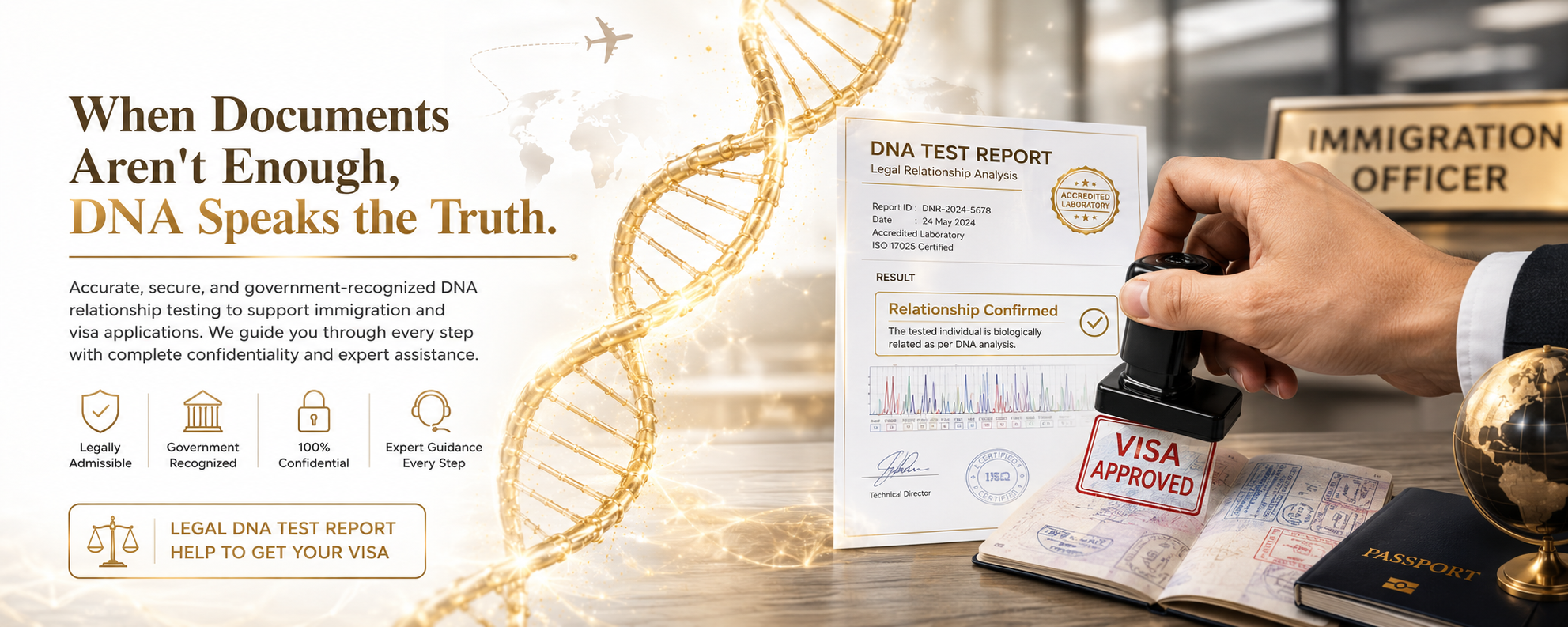
Trusted Immigration DNA Testing for Family Reunification & Visa Applications
When official documents are unavailable or insufficient to establish a biological relationship, an Immigration DNA Test provides scientifically validated genetic evidence to support family-based immigration and visa applications. DNA relationship testing is widely accepted by many immigration authorities worldwide to help verify claimed biological relationships between family members.
At EVIDEXA DNA Test solution Pvt Ltd, we provide Immigration DNA Testing in India using advanced forensic DNA analysis. Our testing is performed with 30+ STR (Short Tandem Repeat) genetic markers, covering 100% CODIS and NDNAD Core Markers, ensuring highly accurate, internationally accepted, and confidential results. Every report is generated through ISO & Govt-accredited laboratory facilities, following strict quality assurance and chain-of-custody procedures.
Immigration DNA Tests In India Offered by Evidexa DNA Test Solution Pvt Ltd
Applicants and sponsors located in India may need to complete DNA sample collection in India while another participant is located overseas.
Evidexa DNA Test Solutions Pvt. Ltd. can coordinate immigration relationship DNA testing for participants located in different countries, subject to the requirements of the relevant case and testing arrangement.
International cases may involve:
Participant in India → Participant overseas → Coordinated identity verification → Witnessed collection → Laboratory analysis → Immigration DNA report
The exact procedure depends on:
- Destination country
- Immigration authority
- Relationship being tested
- Location of each participant
- Identification documents available
- Laboratory requirements
- Sample collection requirements

Immigration DNA Tests Offered by Evidexa DNA Test Solution Pvt Ltd
Immigration Paternity DNA Test
An immigration paternity test determines whether an alleged father is the biological father of a child.
This is one of the most frequently requested immigration DNA tests and may be relevant when a parent-child relationship needs additional biological evidence.
Typical participants:
Alleged Father + Child
For stronger statistical evaluation, testing the child’s mother may also be recommended depending on the circumstances.
Immigration Maternity DNA Test
An immigration maternity test examines whether a woman is the biological mother of a child.
This can be useful when documentary evidence of the maternal relationship is unavailable or requires additional biological confirmation.
Typical participants:
Mother + Child
Immigration Parentage DNA Test
Where appropriate, parentage testing can examine a claimed biological relationship between a child and one or both parents.
A trio test involving:
Mother + Alleged Father + Child
can provide a more comprehensive genetic assessment than testing only two participants.
Immigration Sibling DNA Test
Sibling DNA testing evaluates whether two individuals share one or both biological parents.
It may be considered where a claimed sibling relationship needs additional evidence.
Depending on the case, testing may evaluate:
- Full-sibling relationship
- Half-sibling relationship
Immigration authorities may have specific requirements concerning the laboratory, methodology and interpretation of sibling DNA testing.
For example, USCIS guidance recognizes DNA results as potentially probative evidence of full- or half-sibling relationships in appropriate immigration cases, subject to its requirements.
Immigration Avuncular DNA Test
An avuncular DNA test evaluates a biological relationship between:
Aunt/Uncle ↔ Niece/Nephew
This type of testing may be useful where the alleged parent is unavailable for testing.
The statistical evaluation may determine whether the tested individuals are genetically consistent with the claimed avuncular relationship.
Immigration Grandparentage DNA Test
A grandparentage DNA test examines whether an individual is biologically related to a claimed grandparent.
This can be particularly useful where the alleged parent is unavailable, deceased or otherwise unable to participate in testing.
The appropriate test design depends on which family members are available.
Immigration DNA Test for Family Reunion
DNA testing can sometimes provide supporting evidence in family-reunification cases where the biological relationship needs additional verification.
Potential situations include:
- Child joining parent overseas
- Parent joining child
- Family members separated between countries
- Establishing biological parentage
- Establishing sibling relationships
- Establishing grandparent relationships
- Supporting citizenship-by-descent applications
DNA testing should be considered as part of the overall evidence for the immigration case rather than as a replacement for required immigration documentation.
UK Immigration DNA Test
A UK immigration DNA test may be used as supporting evidence of a biological relationship in appropriate immigration cases.
Applicants may be required to provide photo identification and passport-style photographs during the collection process.
DNA evidence is not a substitute for all other immigration evidence. The immigration authority decides what evidence is required and how it is assessed.
UK Home Office DNA Test Process
- Initial consultation
- Determine the required relationship test
- Confirm applicable immigration requirements
- Arrange identity verification
- Schedule witnessed sample collection
- Collect DNA samples
- Securely package and transfer samples
- Laboratory DNA extraction and analysis
- Statistical relationship evaluation
- Preparation of the DNA report
- Secure delivery of the completed report
Where testing is being undertaken specifically for a UK immigration matter, participants should follow the instructions provided by the relevant authority and testing laboratory.
USA Immigration DNA Test
DNA Testing for USCIS & U.S. Immigration Cases
A DNA relationship test may sometimes be used as evidence in U.S. immigration cases where documentary evidence of a claimed biological relationship is unavailable or considered unreliable.
The applicable requirements can differ according to the relationship and immigration benefit involved.
USCIS guidance specifically discusses DNA evidence for sibling relationships and indicates that DNA testing from an appropriately accredited laboratory may be considered when primary evidence is unavailable or unreliable.
For U.S. immigration DNA testing, applicants should carefully follow the instructions associated with their particular case.
Canada Immigration DNA Test
DNA Testing for Canadian Immigration
DNA relationship testing may be used in appropriate Canadian immigration cases when documentary evidence is insufficient to establish a claimed biological relationship.
Canadian immigration guidance recognizes DNA testing as an option for applicants who cannot provide satisfactory documentary evidence of a relationship.
Depending on the case, DNA testing may be relevant to establishing:
- Parent-child relationships
- Biological parentage
- Other qualifying family relationships
Applicants should follow the specific instructions provided by the Canadian immigration authority regarding laboratory selection, sample collection and submission of results.
Australia Immigration DNA Test
DNA Testing for Australian Visa & Citizenship Applications
The Australian Department of Home Affairs recognizes DNA testing as one possible form of evidence for establishing a claimed biological family relationship.
DNA testing may be relevant to certain visa and citizenship matters, particularly where documentary evidence is unavailable or unreliable.
Australian government information states that applicants undertaking DNA testing must use a laboratory meeting the applicable requirements, including NATA accreditation for family law testing and additional requirements for international testing.
For Australian citizenship by descent, the Department may invite an applicant to undertake DNA testing to confirm a claimed biological parent-child relationship. The Department advises applicants not to begin testing before receiving its instructions because results may not be accepted if the specified requirements are not followed.
Choose Evidexa DNA Test Solution Pvt Ltd for Immigration DNA Testing
Professional Relationship Testing
We focus on biological relationship testing using established DNA analysis methodologies.
International Case Coordination
We assist with cases involving participants located in different countries, subject to the applicable testing requirements.
Identity & Sample Control
Immigration testing requires greater control over participant identification and sample handling than ordinary private testing.
Confidentiality
DNA information is highly personal. We maintain appropriate confidentiality and controlled handling of client information and test results.
Clear Communication
We explain the testing process in simple language before sample collection.
Multiple Relationship Tests
Our services can cover:
- Paternity DNA Test
- Maternity DNA Test
- Parentage DNA Test
- Siblingship DNA Test
- Half-siblingship DNA Test
- Avuncular DNA Test
- Grandparentage DNA Test
- Other biological relationship testing
Get an Immigration DNA Test
If you need a DNA test for an immigration, visa, citizenship or family-reunification matter, contact Evidexa DNA Test Solutions Pvt. Ltd.
Tell us:
The country you are applying to
The immigration authority involved
The relationship you need to establish
Where each participant is located
Whether you have received an official DNA testing request
Any specific laboratory or collection instructions provided to you
Our team can then explain the appropriate testing process and the documentation required for your case.
Request Your Immigration DNA Test Consultation
Evidexa DNA Test Solutions Pvt. Ltd.
Immigration DNA Testing | Paternity | Maternity | Siblingship | Avuncular |